This post is also available in:
 Français
  Русский
The Era of Development and Tourism
The first modern hotel in Phuket was built in the 1960s, marking the beginning of a new era for the island. By the 1970s, beach tourism began to flourish, driven by the arrival of Western travelers. This coincided with the decline of the tin mining industry, which finally collapsed in the mid-1980s after a brief resurgence fueled by the demand for tantalum, a by-product used in electronics.
With the demise of mining, Phuket’s economy pivoted entirely towards tourism. Dubbed the “Pearl of the Andaman,” the island quickly became a top tourist destination. This influx of tourism brought with it significant changes: Western culture, modern infrastructure and technology, along with credit systems, were introduced to this once-sleepy province.
The booming tourism industry, coupled with a growing expat community and a sharp rise in population, ignited a surge in consumption and real estate development. This, in turn, fostered the growth of a local media and advertising industry, further accelerating the transformation of Phuket’s society.
The 1997 Asian Financial Crisis had a significant impact on the island. Thousands fled Bangkok for Phuket, seeking employment and escaping debt. Simultaneously, Thailand opened its economy to foreign investors. In recent years, retail giants like Central, Tesco, Lotus, and Makro established themselves in Phuket’s city center, gradually displacing small local businesses.
While some families with ties to the trading and mining industries diversified and thrived, others capitalized on the tourism and real estate boom by converting their landholdings into resorts, residential properties, or shopping malls. Today, Phuket boasts one of the most dynamic real estate markets in Asia, with “luxury villas with private pools” catering to affluent foreign clientele. This has brought economic benefits to locals, but also fueled a sense of disparity. As the saying goes, “One day, Phuket will belong to the farang (foreigners).”
This real estate gold rush attracts Western investors (often married to Thai women), Chinese investors from Bangkok, and Phuket’s own Baba capitalists (descendants of Chinese immigrants). Interestingly, some Sino-Thais are utilizing Sino-Portuguese architecture to differentiate their developments, aiming to attract a primarily Thai market. While this trend originated in Bangkok, it has resonated with developers in Phuket.
This resurgence of the “Sino-Portuguese style” can be interpreted as a way for Phuket’s Sino-Thai community to assert their Baba identity within the contemporary economy while competing with foreign investors in the “recolonization” of the island.
By 2004, Phuket’s tourism industry was considered “overdeveloped.” The island boasted over 500 hotels offering 30,000 rooms, attracting nearly 3 million tourists annually. This influx of tourism revenue benefited thousands of local businesses and transportation providers. However, the 2004 tsunami dealt a devastating blow to the industry, leaving many businesses struggling to recover.
Phuket’s prosperity has come at a cost. Khun Tira Kienpotiramard, who established Phuket’s first travel agency in 1970, reflects on “opening the door” to tourism but being unable to control its growth. He laments the decline in security, particularly in Phuket’s suburbs, attributed to an influx of foreigners, including unregistered Thai migrants and illegal Burmese workers. He also expresses concern over the environmental degradation caused by rampant tourism development.
Amidst the upheaval of Phuket’s society and cultural landscape, those championing Baba identity have reclaimed their space in Phuket’s historic center, offering a glimpse into the island’s rich heritage.
Preserving the Old Town
Historically, the study of Thai architecture focused on the essence of Thai dwelling styles rather than acknowledging regional variations. Consequently, Phuket’s distinctive cityscape was largely overlooked in representations of “Thai architecture.” It was only in the last two decades, with recognition from the Association of Siamese Architects and the National Cultural Commission, that the appreciation for Phuket’s urban landscape began to grow among Thais.
Ironically, the increasing popularity of Phuket’s architecture originated from the misnomer “Sino-Portuguese,” coined by architects to describe its unique style. This term, though inaccurate, has a certain charm. It is believed to have been inspired by Macau, the wife of architect Sumet Jumsai’s hometown. While the architecture owes more to building traditions from the British Straits Settlements, the term stuck.
The “Sino-Portuguese” label, though misleading, proved more palatable than alternatives. The Portuguese, after all, were the first Europeans to introduce Western cultural styles, terracotta construction, and roof tile production to Southeast Asia. Their colonial legacy is now perceived as less imposing than the French, British, or Dutch, given its historical distance. Additionally, the “Chinese” element in “Sino-Portuguese” resonated more easily than, for example, “Luso-Chinese.” “British Straits Settlements,” on the other hand, remained an abstract concept for many Thais and Chinese. Thus, “Sino-Portuguese” prevailed.
Over the past two decades, development agencies, academics, and Phuket’s municipality have collaborated to revitalize the old town. A significant driving force was Dr. Yongtanit Pimonsathean, a young professor at KIMTL, who spearheaded efforts between 1997 and 2002. The old town was designated a “cultural heritage conservation zone” by the Office of Environmental Policy and the National Environment Board. The 2004 Municipal Development Plan encompassed 19 rai (approximately 0.5 square kilometers) of the city center within this protected zone.
Eight streets lined with shophouses, built between the late 19th and mid-20th centuries, form the core of historic Phuket. Thalang Road, the main artery, with its 141 shophouses, extends seamlessly into Krabi Road. Villas, once located on the outskirts, have been absorbed into the expanding urban fabric. Two ancient temples, Wat Kachon (Kajorn) and Wat Puttamonkon (Kallang), along with their affiliated schools, stand respectively south and north of the old town.
Successful collaborative renovations fostered a spirit of cooperation between homeowners and the municipality. This culminated in the launch of the “Old Phuket Town Festival” in December 1998.
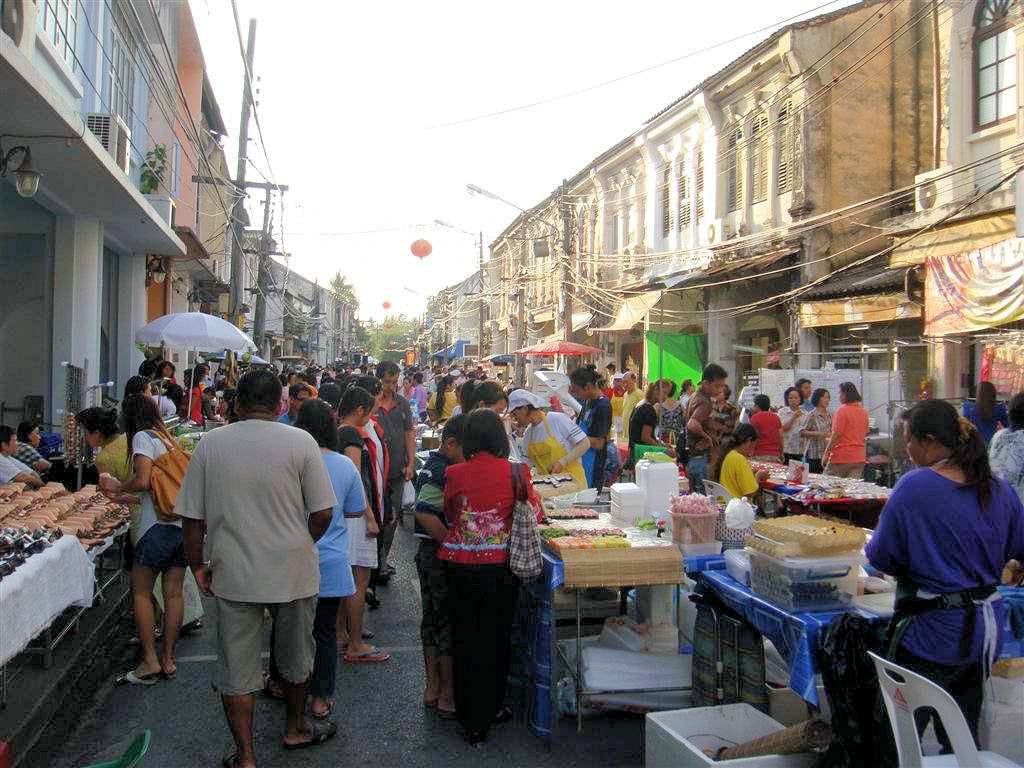
The Thai Hua School hall, a hub for community forums, hosted an exhibition on Baba culture and lifestyle during the inaugural festival. Now an annual event, the “Old Phuket Town Festival” celebrates the unique heritage of Phuket’s Baba community by showcasing its “Sino-Portuguese” architecture, cuisine, visual arts, costumes, and customs. For three days, Thalang Road transforms into a vibrant night bazaar, hosting processions that draw thousands of residents and tourists.
In 2003, the Old Phuket Foundation (OPF) was established to spearhead conservation efforts, supported jointly by the government, the business sector, and the community.
LE MOUVEMENT DE LA VIEILLE VILLE
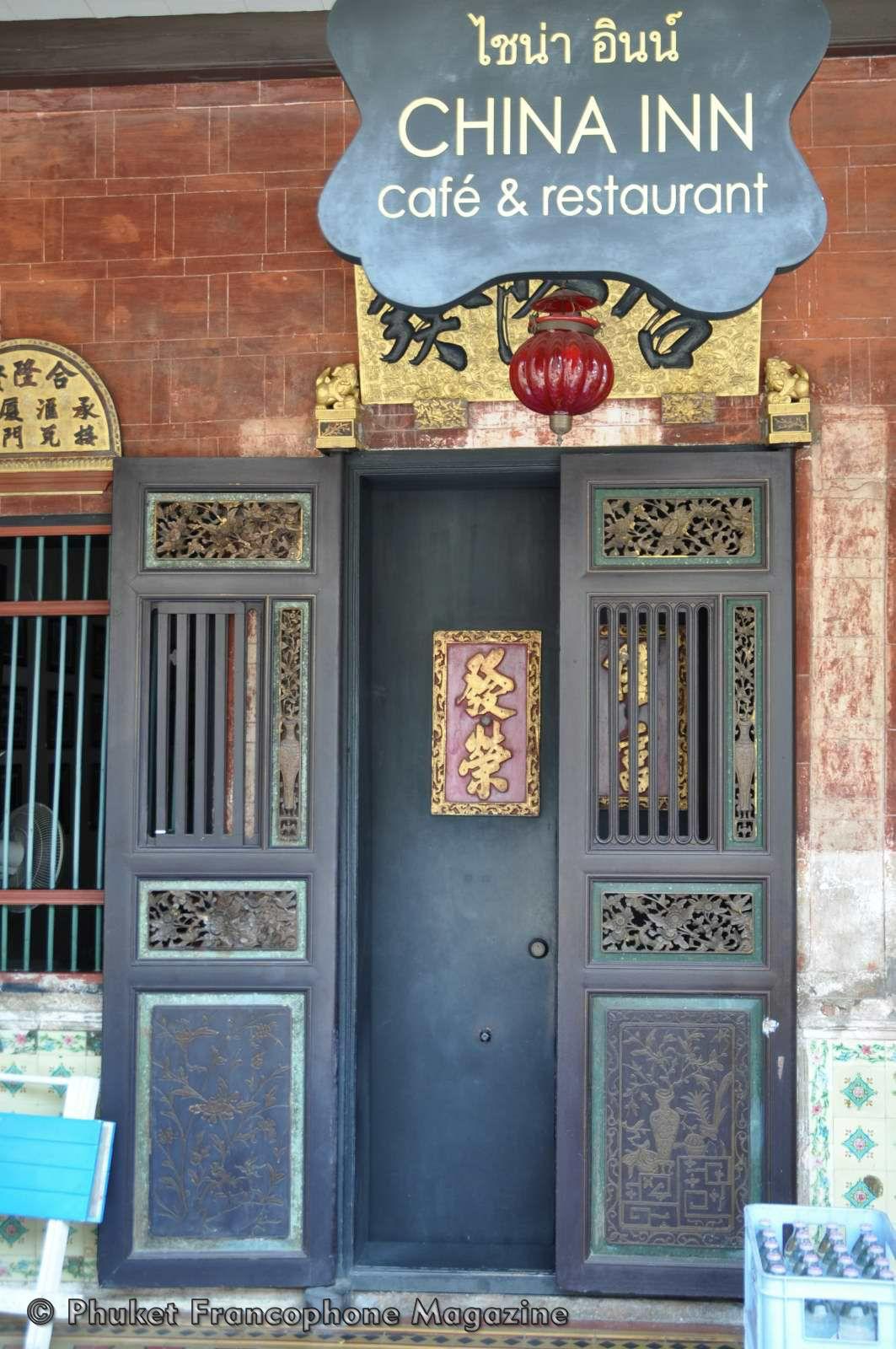
Old Phuket exudes an undeniable charm, fostering a profound sense of belonging among those who grew up there. The area boasted the best schools, and Seng Ho, Thailand’s oldest bookstore established in 1925, graced Thalang Road. Today, many descendants of miners and merchants raised around Thalang and Krabi Roads hold influential positions within the community.
A collective yearning to restore the old town to its former glory fuels the “Old Town Movement.” This multifaceted movement encompasses various initiatives: the municipality, the “Old Phuket Festival,” the “Old Phuket Foundation,” and the “Thai Hua School Museum” project.
Several timelines intertwine within this movement. Initially spurred by a desire to preserve the “Sino-Portuguese” architecture and urban heritage, this responsibility now rests with the municipality and the “Old Phuket Foundation.”
Concurrently, a cultural and linguistic movement focuses on Chinese identity, led by Mandarin-speaking alumni of the Thai Hua School. Mirroring a trend across Southeast Asia, many Thai-speaking Chinese families are choosing Chinese education for their children, while adults pursue private Mandarin lessons. These alumni envision transforming the Thai Hua School into a museum celebrating Phuket’s Sino-Thai heritage.
A third timeline centers on Baba identity and culture, championed by descendants of early settlers who, while often fluent in Hokkien and English, may not speak Mandarin. They prioritize the preservation of Phuket Hokkien dialect and distinct cultural practices.
The “Old Phuket Festival” embodies this distinction. As one organizer notes, “You won’t find our customs, attire, or desserts in China.” While some traditions are rooted in Chinese culture, others bear similarities to those of Penang’s Baba community. However, many are uniquely Phuket’s own, a fusion of Hokkien and southern Thai influences. The old town symbolizes the heart of Phuket’s Baba identity, the cradle of its cultural development.
Khaw Sim Bee Na Ranong. Ancien gouverneur de Phuket.
Adjarn Pranee Sakulpipatana, an assistant professor at Phuket Rajabhat University instrumental in establishing the Phuket Cultural Center, plays a vital role in the revitalization efforts. Her research on Khaw Sim Bee history led her to Penang in 2001. Since then, she has spearheaded Phuket’s participation in annual Baba conventions held in Singapore, Malacca, and Penang, while also lobbying the Thai government to recognize Phuket’s Baba community as a distinct cultural minority.
Early apprehensions about the societal acceptance of Baba and Chinese cultures have dissipated, evidenced by the festival’s popularity among Sino-Thais, ethnic Thais, and tourists. The current climate of cultural liberalization, particularly towards Sino-Thais under the Thaksin government, encouraged organizers to align the seventh “Old Phuket Town Festival” with the Chinese New Year in February 2005. Special attractions included traditional New Year delicacies, dragon dances, and Chinese opera.
Although no longer Phuket’s commercial hub, Thalang Road continues to attract visitors seeking textiles, linens, jewelry, restaurants, and medical services. Dr. Prasit, a former Phuket provincial government executive raised on Krabi Road, emphasizes the need to maintain a vibrant community, “otherwise, they’ll sell their homes and leave.”
He believes economic revitalization is crucial for the old town’s sustainability. Initiatives like a “pedestrian street” offer hope that the area will finally benefit directly from tourism. “If we don’t act now,” he warns, “we might miss a historic opportunity.”
Following the 2004 tsunami, funds earmarked for Phuket’s economic recovery facilitated the largest street festival ever staged: the “Phuket Cultural Street Revitalisation Festival.” Held every weekend from September 23rd to November 6th, 2005, it was a collaborative effort between the National Office of Culture, the Phuket Provincial Administrative Organisation, Phuket Rajabhat University, Phuket Municipality, the Phuket Hokkien Association, and the Old Phuket Foundation.
Simultaneous cultural performances, primarily along Thalang and Krabi Roads, and open houses in private residences showcased the island’s cultural tapestry. While emphasizing Baba culture, the festival also featured performances by the Chao Leh (sea gypsies) and local and international artists. Highlights included a Baba seminar with Malaysian speakers and a mass Baba wedding ceremony with 48 participating couples.
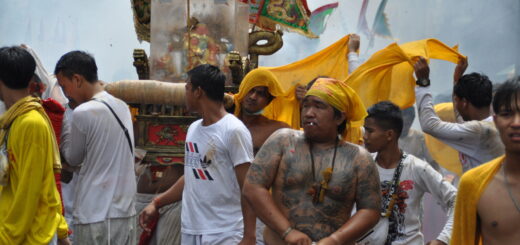
Coinciding with the nine-day Vegetarian Festival, the festival culminated with the awe-inspiring procession of the “Nine Emperor Gods,” creating an unforgettable spectacle for visitors.
Khun Somchai Seanglai, Deputy Secretary-General of the Ministry of Culture and National Cultural Commission, oversaw the event. As a Chinese descendant from Trang, he emphasized, “Local culture is vital for tourism, and Baba culture is a valuable asset for Phuket.”
Cultural Tourism
Phuket’s emergence as a major tourist destination in the 1970s was partly due to its existing urban infrastructure. A skilled workforce, transportation networks, and service industries were already in place, readily supporting the influx of five-star hotels. The island cultivated an image of a secluded paradise, despite its bustling city center. Locals became synonymous with welcoming smiles and friendly service in tourism imagery.
Most foreign tourists arriving in Phuket gravitate towards familiar Western-style hotels, seafood, and international cuisine. While some venture into “Thai” experiences, sampling local dishes, they often remain oblivious to the unique nuances of Phuket’s cultural tapestry. They fail to realize that the local cuisine, culture, and architecture diverge significantly from their mainland counterparts.
This perception is further reinforced by the predominantly non-local staff in beach resorts. Managers, chefs, waitresses, and masseuses often hail from Bangkok or Isan. Even long-term expats, with their lives revolving around international schools, shopping malls, and familiar restaurants, rarely venture into Phuket town, remaining detached from its authentic essence.
Ironically, Thai staff working in these resorts often refer to the old town as “the Chinese town,” implying foreign allegiance among its residents. This label amuses Phuket Babas who, considering themselves the true locals, view these mainland Thais as transient newcomers seeking fortune before returning north with their earnings.
“Phuket is like a tiger,” remarks a young accountant, “and we see these hungry dogs coming here for gold. But we remain calm. We can buy anything we want, but I no longer feel comfortable. It’s becoming like Bangkok. This needs to change.”
As more northerners settle in, their perceptions of Phuket become increasingly dominant. This influx threatens the Baba identity, forcing them to confront a superficial, mass-produced image of their home.
However, a recent surge in interest towards local cultures offers a glimmer of hope. Perceptions of southern Thais are shifting from a negative image – a people devoid of “Thai” culture – towards a positive one – a people with a distinct and “discoverable” local culture.
Interestingly, this cultural tourism movement in Phuket is driven not by the tourism industry or expats, but by local residents, particularly educated Babas who, having traveled abroad, have developed a renewed appreciation for their own heritage. They envision promoting their culture through carefully curated tourism experiences.
The late Khun Pracha Tandavanitj, custodian of the Pithak Chinpraca House, stands as a pioneer in this movement. Inspired by his visits to historical homes in Britain, he began opening his home to the public in 1980, a practice he continued daily for a decade. “Phuket’s culture is unique,” he believed, “If Chiang Mai can attract so many tourists, why not Phuket?”
In contrast to the standardized portrayals offered by the mainstream tourism industry, Phuket Babas strive to showcase Thalang Road as the heart of the “real Phuket” – a testament to the Baba culture interwoven with the legacy of tin mining, albeit with a more inclusive approach.
For them, cultural tourism transcends mere economic strategy. It’s about reclaiming their Baba identity and presenting it to a wider audience – young Phuket Babas, foreign tourists, expats, mainland Thais, and influential figures from Bangkok. It’s about preserving their heritage for future generations.
CONCLUSIONS
Phuket presents a unique case study in Thai-Chinese and Thai-Muslim relations, diverging from the typical narrative. Here, Hokkien Babas exist as a minority within a predominantly Teochew Chinese Thai population. Similarly, Thai-speaking Muslims remain peripheral to the Malay-speaking majority, who act as the primary interpreters of their faith. Both groups identify more strongly with southern Thailand than with Bangkok, a sentiment reflected in their tendency to vote for Democrat candidates over “Rak Thai,” regardless of religious affiliation.
Identity transcends cultural boundaries, carrying political weight as a marker of group belonging, ownership, rights, territory, and legitimacy. In their struggle to navigate the cultural hegemony of the nation-state, both Sino-Thais and Malay-speaking Thai Muslims have resiliently asserted their cultural identities within a fluctuating political space, constantly expanding and contracting under shifting policies. In Phuket, the boundaries of social discourse are being redrawn to accommodate the demands of tourism, creating opportunities for cultural champions to articulate their identities in the name of diversity.
Paradoxically, recent crises have yielded unexpected benefits. The rise of cultural tourism has propelled Phuket’s Muslims and Babas to the forefront of the island’s economic revitalization. Furthermore, the ongoing conflict in southern Thailand has strengthened the position of Phuket’s Muslims as allies of the Democrat government.
Having spent the past three decades catering to the “farang” (Western) perception of Phuket, locals are now reclaiming their narrative. While mass tourism continues to flock to the beaches and nightlife of Patong, niche markets like cultural and eco-tourism offer a viable path towards cultural renewal and empowerment.
Opportunities for cultural performance allow communities to strengthen group identity, forge connections, and emerge as active players in the tourism industry. However, while tourism provides economic resources and momentum for cultural revival, it also risks commodification. Narratives presented to tourists can veer towards the inauthentic, the outlandish, or the blatantly false. Yet, it is precisely this fluid space, where carefully crafted official narratives intersect with sanitized tourist versions, that promises the most fertile ground for exploring diverse interpretations, from the serious to the whimsically rewritten history.
At a grassroots level, communities and cultural groups respond to social change and globalization in two primary ways. The first is through intensified ethnicity, or re-ethnicification, facilitated by media, travel, and the internet. This often manifests as a personal journey of rediscovering one’s identity, ancestry, and roots. The second is through intensified religious practice, exemplified by the growing popularity of Islamic revivalism and the success of events like the “Nine Emperor Gods” festival. Both serve as powerful assertions of belonging within a larger social fabric.
The arbitrary nature of the Thai-Malay border, encapsulated in the phrase “one peninsula, two nationalities,” has been extensively studied. Border communities often view such lines as points of connection rather than division. For Phuket’s Babas and Thai-Muslims, revitalizing cross-border ties with their counterparts represents an act of defiance against the tide of Thai homogenization, reaffirming their southern identity and shared cultural affinities.
As culturally marginalized groups grapple with identity politics and promote communal ethnocentrism, social memory, and historical narratives, their efforts can be bolstered by academic research. Collaboration between Thai and Malaysian scholars to document “cousin communities” along the border can not only support their cultural survival but also encourage authorities to embrace the richness of diversity within their populations. Ultimately, culture-sensitive approaches to peacebuilding are essential for fostering lasting harmony and a sense of belonging among communities long marginalized by the nation-state.